


Intergenerational Elasticity
The degree to which members of society have equal opportunity of success, irrespective of their family background, is often measured by intergenerational elasticity of income. Roughly, it measures what percentage of inequality between members of the generation is passed on to the members of the next generation. Here is a definition from The Economy by CORE:
[C]onsider two pairs of fathers and children. The father in the first pair is richer than the father in the second. The intergenerational elasticity measures how much richer the child of the well off father will be than the child of the poorer father. An elasticity of 0.5, for example, means that if one father is 10% richer, then his child, when grown up, will be on average 5% richer than the other child.
The following graph show the relation between inequality and intergenerational income elasticity. Sometimes it is called The Great Gatsby Curve .
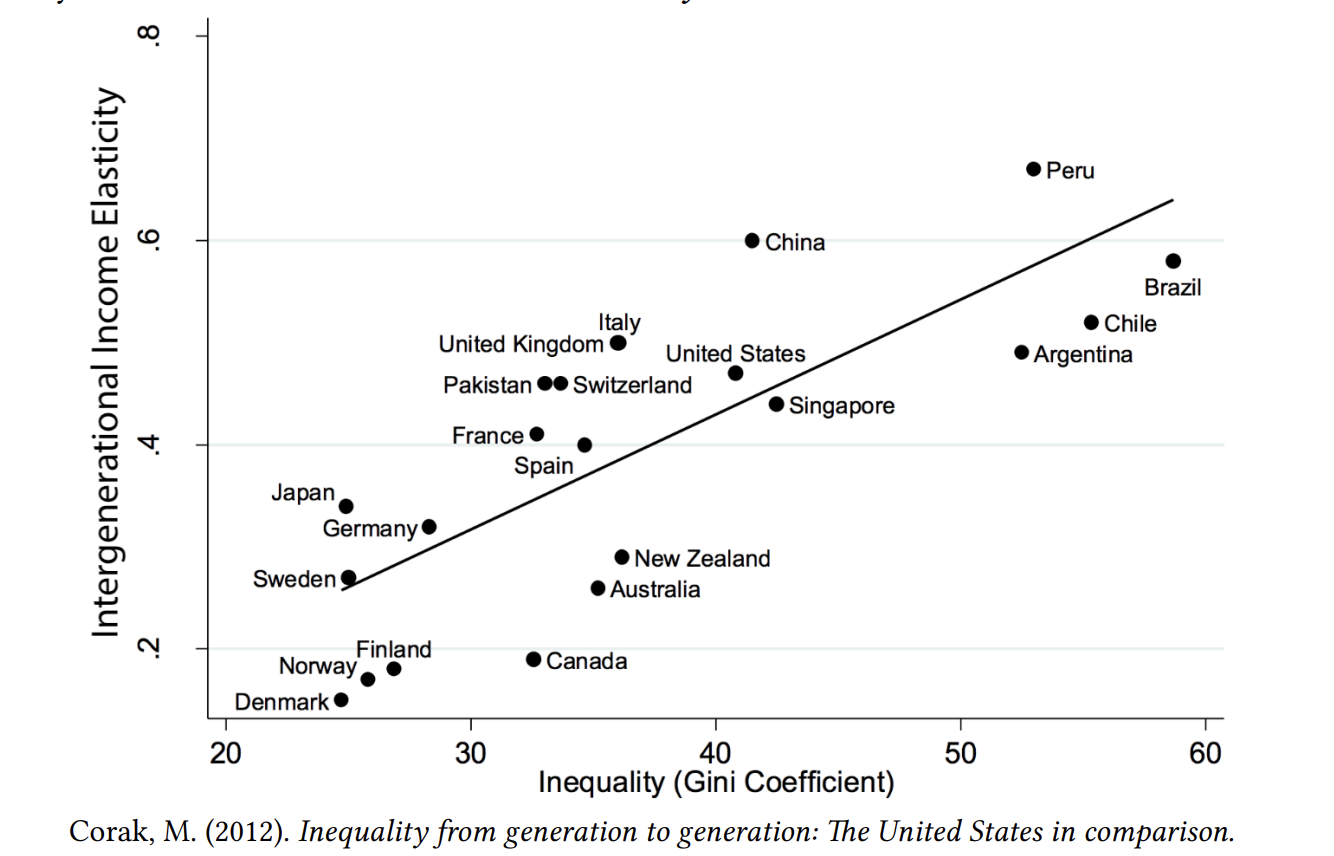
Provide two distinct economic arguments that explain the positive correlation between current inequality (measured by the Gini coefficient) and intergenerational inequality.
Ответ
In grading we valued clarity of the exposition and well connected arguments. We took into consideration that the statement of the question does not specify whether the Gini coefficient refers to pre-or post-tax income.
In the answer, students should address two arguments in line with those presented in the following list:
-
Ability: more able parents have higher income and transmit their ability to their kids (when income represents labor productivity).
-
Inheritance: higher income parents accumulate more wealth and their children receive a higher inheritance (income from wealth).
-
Arguments related to imperfections
-
Children from higher income parents enjoy better opportunities to increase their income via access to education, parental care,...
-
Children from higher income families do no suffer from credit constraints
-
Segregation and discrimination
-
Inequality leads to institution failures: favoritism in the labor market, corruption...