


Water Restrictions
Residents of Catalonia (autonomous community of Spain) during the winter of 2023-24 faced water usage restrictions due to drought. Fountains were turned off, watering lawns, filling pools, washing streets and house facades were prohibited; restrictions also affected public showers and car washes. When the author of this task asked GPT-4 how the introduction of such restrictions could affect the price of water, he received the following response:
The reduction in water availability can lead to an increase in its cost to cover expenses for extraction, purification, and distribution. When water becomes a scarce resource, its extraction and delivery to consumers require additional costs, for example, through the use of alternative water sources or enhanced purification.
Indeed, economics textbooks typically state that a quota (limitation of the quantity of a good) leads to price increases. However, the goal of the restrictions imposed by the government of Catalonia is, on the contrary, to prevent excessive price increases for households — water consumers.
(a) (12 rp) Construct an economic model of the perfectly competitive market with two groups of consumers (car washes and households), which demonstrates that restricting water consumption for one group of consumers (car washes) can lead to a decrease in price compared to equilibrium without intervention. Provide the analytical or graphical solution of your model. Assume that the quota for car washes is below their level of water consumption at equilibrium but above zero, and that car washes can trade quotas, meaning the most economically efficient among them will buy water.
Ответ
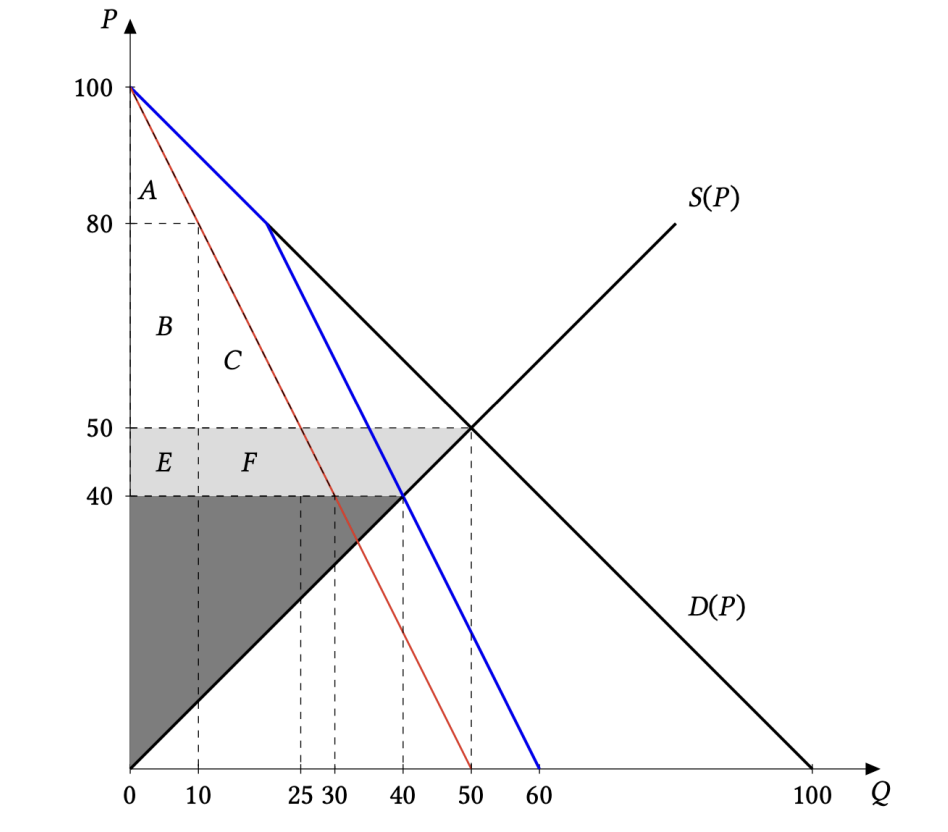
(a) Assume the water supply is described by the function , the demand of the first group (car washes) is given by , and the demand of the second group (households) is . Total demand is , equilibrium without intervention is , and consumption of each group is 25.
If the government imposes a restriction on water consumption for car washes at the level of , then total demand will be . With the intervention, the price is , which is lower than the price without restrictions, and household consumption will increase from 25 to 30..
Graphical representation follows below. The red line is the demand function of any group of consumers, the blue line is the new demand function.
(b) (9 rp) How does such government intervention in your model affect the surpluses of each group of consumers and producers, as well as the overall social surplus (welfare)? Provide calculations or show graphically. Can one specify functions and parameters of the model so that the impact on the social surplus is reversed?
Ответ
(b) Households benefit: they buy more and cheaper. Their surplus in the model used to be areas , now it is . Numerically, that is an increase from 625 to 900.
The surplus of car washes may change in any direction: they buy less and cheaper, and with inelastic supply, the price effect may outweigh. In this model, they lose: they used to have a surplus of , now it is .
Water producers lose unambiguously: they sell less and cheaper. Their surplus used to be light shaded area (1250), now it is only dark shaded area (800).
The overall surplus inevitably decreases since it was previously maximized (in perfect competition without regulation). In this model, it has decreased from to .
(c) (9 rp) Suppose the government can regulate the price of water for car washes, and resale of water between consumer groups is impossible. Instead of setting a quota for car washes, the government increases the price for them to reduce their consumption to the level of the previous quota. The price for households is set at the equilibrium level. Analyze this approach compared to the quota in terms of the surplus of each group of consumers and producers.
Ответ
(c) The output in the market does not change, nor does the price for households. Therefore:
-
Households are unaffected.
-
Car washes are worse by area B off due to higher prices.
-
Producers are better off by area B due to higher prices for car washes.