


Substitutes and complements
Consider two commodities, A and B, that are substitutes in consumption.
a) (10 pr) Suppose that the number of consumers of good A increased, thus shifting the demand for it. Assuming perfect competition in both markets, what can you say about the resulting change in the price of B? Explain in detail.
Ответ
If number of customers for good A increases, this means that demand for good A will increase and demand curve will shift to write thus increasing price and quantity demanded for product A (see Pic.1)
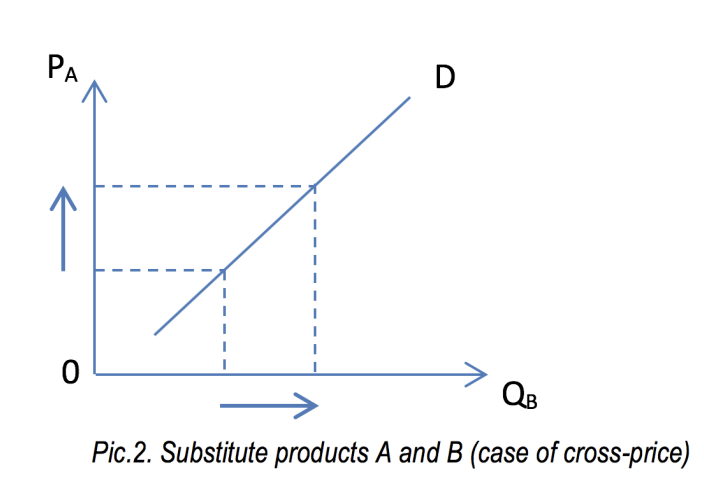
Growing demand for product A will increase the pressure on the price of the product A, thus causing consumers reconsider the choice of product A and switching to substitute product B (see Pic.2)
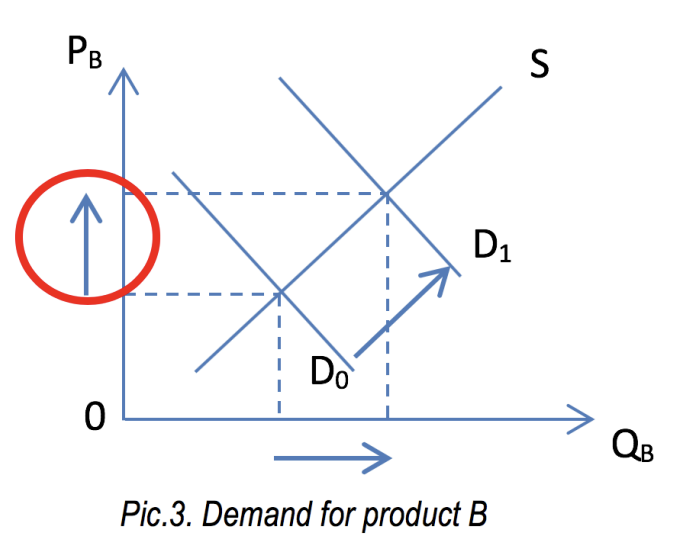
If customers are switching to product B then this puts also a pressure on the price of product B. Price of product B increases.
b) (10 pr) Suppose that A and B are not only substitutes in consumption but also complements in p
Ответ
If goods A and B are also complements in production, increase of quantity supplied of A will increase also the supply of B thus causing the downward pressure on the price of B (see Pic. 4).
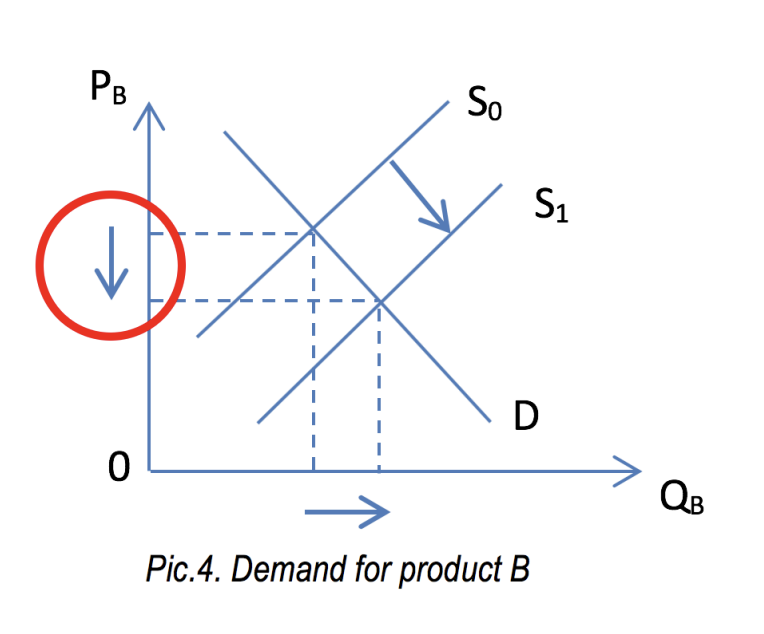
Combining Pics 3 and 4, we infer that the effect on the price of B is unclear.
c) (10 pr) Give a real-world example of two commodities that are both substitutes in consumption and complements in production.
Ответ
Complements in production are two or more goods that are jointly produced using a given resource. The production of one good automatically triggers the production of another, often as a by-product. Both goods are simultaneously produced from the same resources. Production of one good does not decrease the production of the other, as would be the case for substitutes in production.
Real-life examples: 1. Oil and Gas 2. Chicken wings and chicken breast 3. Milk and yogurt