


Competition, Innovation, Inflation
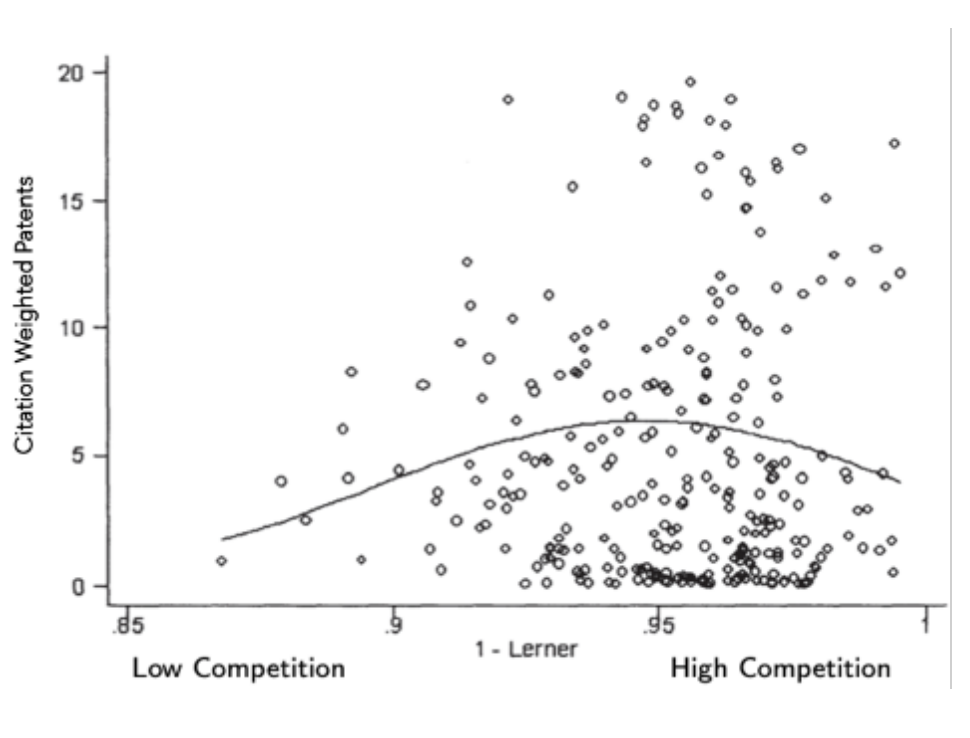
(a) (10 rp) In their 2005 paper1, Philippe Aghion, Nick Bloom, Richard Blundell, Rachel Griffith, and Peter Howitt found the inverted-U empirical relationship between the level of competition and the level of innovation in various industries. That is, not much innovation is seen in very competitive industries as well as in highly concentrated industries, most patents are acquired by firms in moderately competitive industries. Explain why this may be the case.
Ответ
(a) Crucial ideas:
-
In highly competitive industries, the innovation rents cannot be high, unless the innovator makes a real breakthrough and acquires significant market share (which is unlikely). So, both incumbent and new firms do not find it profitable to invest in R&D.
-
In monopolized industries, firms do usually have the money to invest in R&D, but are reluctant to do that, if their market power is secured. But more competition induces firms to innovate in order to "escape competition" (in the words of the authors of the paper), since being the first to introduce a new product or technology can give them a significant advantage over their competitors.
Other arguments may include:
-
In highly competitive industries, the incumbent firms are typically small, do not earn high profits (that can be re-invested in innovation) and may have limited access to the credit market. Thus, it is difficult for them to fund R&D.
-
The firms in low-competition markets, if faced with the threat of increased competition, may start innovating more to avoid losing their market shares.
No more than one idea explaining a part of the inverted-U is awarded points (i.e., if there are two arguments explaining the increasing part, only one of them gets points). Each of the crucial ideas is worth 5 points. Plausible, but not the same or not very well explained ideas are awarded with 3 points. If there are both correct (earning 5 points) and incorrect arguments, the explanation gets 4 points for each part ( and ).
If the contestant provides correct arguments for low levels of innovation with low and high competition, but also says why under moderate level innovation will also be low (that is, fails to explain the inverted U), they get 5 points in total.
(b) (10 rp) One of the ways to regulate non-perfectly competitive markets and reduce their detrimental impact on social welfare is a price cap. In a standard model, the government sets the maximum price at the level where it would be in perfect competition , so the firm(s) produce the socially efficient level of output. In some cases, however, this policy is not feasible, because it forces the firm(s) to leave the market, harming the society even worse. Provide an example of such a market where forcing is clearly not the best idea and explain why. Suggest another way of regulation, that can help achieve the goal instead (or in addition to) the price cap.
Ответ
If marginal cost is lower than average cost, setting will induce the firm to leave the market. This may happen with natural monopolies or simply with firms with a high fixed component in their cost structure. For example, for a cinema, letting one more person in costs nothing (MC 0), the situation is similar for airlines, digital content producers, public transportation, etc. Setting P = MC there will mean destroying the revenue. For the pharmaceutical industry, setting P at the competitive level (= MC) would kill incentives for R&D, and new drugs will not be developed (see part (a)).
- 3 points for an example, 2 points for explaining why regulation is infeasible
- mentioning 'natural monopoly' or 'economies of scale' does not count as an example and brings 2 points out of 3
- a partially correct explanation gets 1 point out of 2
The solution can be, in addition to capping prices, to provide a subsidy which will cover the fixed cost (or, similarly, share the cost of R&D) for those firms that still operate in the market. This will make their profit positive again.
- 5 points for correct measure.
- If the measure returns firms back to the market but does not provide allocative efficiency, 2 points out of 5 (this includes the case where a contestant suggests subsidy but fails to identify the reason for the inefficiency correctly).
- If the measure is not obvious (i.e., not a subsidy in addition to price cap), up to 3 points out of 5 can be withdrawn for lack of explanation.
(c) (10 rp) In macroeconomics textbooks, the authors often distinguish between two types of inflation: cost-push and demand-pull. Assume that two equivalent countries are in the long run macroeconomic equilibrium, and they simultaneously experience inflation — cost-push in country A and demand-pull in country B. Using the AD-AS model, explain for which country's government (the central bank) it will be relatively harder to fight this inflation.
Ответ
Cost-push inflation occurs when there is an increase in production costs, such as wages or raw materials, leading to a decrease in aggregate supply (AS). Demandpull inflation, on the other hand, arises when there is an increase in aggregate demand (AD) that outpaces the economy's capacity to produce goods and services.
To combat the inflation, the central bank can implement contractionary policy, such as raising interest rates. These measures aim to reduce aggregate demand and shift the AD curve to the left, helping to mitigate the inflationary pressure.
In country A, the decrease in AS already reduced the output, and this contractionary policy will reduce it even further, driving the economy into a deeper recession. To prevent this, the government should use supply-side (fiscal) policies, which are harder to implement (legislation often needed) and which operate with lags. In country B, on the other hand, the output increased in the short run, so the contractionary policy can return it back, without causing a recession. So, it is harder to deal with cost-push inflation. 10 points for correct explanation, including the understanding of the causes of cost-push and demand-pull inflation.
Partial credit:
- one or the both mechanisms are explained — each gets 2 points;
- the policies that can combat inflation are explained with examples — 2 points in each case (or 4 points if measures apply to both cases)
- the argument is made that it is necessary to use the (operating with lags) supply-side policies in country A without explaining why (to prevent recession) — 1 point is subtracted from the explanation.